
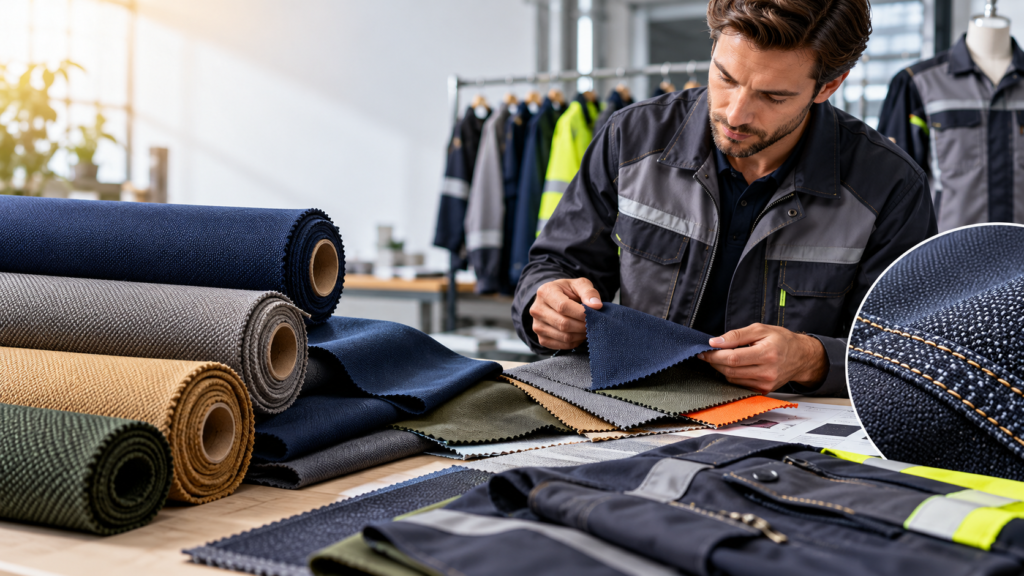
How to Choose the Right Fabric for Industrial Workwear and Employee Uniforms
Industrial uniforms must perform under conditions that are often very different from those experienced by ordinary clothing.
Employees working in manufacturing plants, warehouses, engineering facilities, maintenance departments, and industrial sites may require workwear that balances comfort, durability, mobility, and job-specific protection.
Selecting suitable fabric is therefore one of the most important decisions in industrial apparel procurement.
Why Fabric Selection Matters
Industrial garments may be exposed to repeated washing, surface abrasion, dirt, oils, mechanical movement, heat, and other workplace conditions.
The correct material depends on the actual work performed and the hazards identified in the workplace.
No single fabric is appropriate for every industrial environment.
Common Materials Used in Industrial Uniforms
Cotton
Cotton is valued for its softness, breathability, and moisture absorption.
It can be appropriate for certain general-purpose work uniforms, subject to the workplace’s requirements.
However, ordinary cotton should not automatically be considered protective against heat, flames, chemicals, or other hazards.
Polyester-Cotton Blends
Polyester-cotton blends are commonly considered for general industrial uniforms because they can combine aspects of cotton comfort with polyester’s wrinkle resistance and dimensional stability.
Their actual performance depends on fibre ratio, fabric construction, finishing, and garment design.
Polyester
Polyester is used in various uniform applications because of characteristics such as shape retention and resistance to certain forms of everyday wear.
It is not universally suitable for environments involving heat, flame, or electrical hazards.
Specialized Protective Fabrics
Some working environments require fabrics engineered and tested for specific hazards, including flame-resistant, arc-rated, chemical-protective, or high-visibility applications.
These materials must be selected according to a documented risk assessment and applicable standards.
A conventional industrial uniform is not a substitute for certified personal protective equipment.
Five Factors to Evaluate Before Choosing Workwear Fabric
1. Working Environment
Understand whether employees work indoors, outdoors, in humid areas, or in environments with unusual thermal or mechanical demands.
2. Fabric Weight and Construction
Fabric weight, weave, and construction influence garment feel, durability, flexibility, and comfort.
A heavier fabric is not automatically more protective or suitable.
3. Movement and Ergonomics
Employees may bend, stretch, climb, lift, or operate equipment for extended periods.
Garment patterns should allow the movement necessary for the job without creating unnecessary loose-fabric hazards.
4. Washing and Maintenance
Evaluate expected washing conditions and laundering frequency.
Where relevant, request testing for shrinkage, colourfastness, seam strength, and dimensional stability.
5. Compliance and Safety
For protective clothing, identify the required technical performance and verify supporting documentation, test reports, and appropriate certification.
Why Sample Approval Is Essential
A fabric swatch provides an initial impression, but the finished garment must also be assessed.
Before placing bulk orders, organizations should consider approving a representative sample covering fabric, stitching, fit, fasteners, pockets, reflective details where specified, and branding.
Wear trials may be appropriate for higher-volume or functionally demanding programmes.
Evaluating Total Cost
The cheapest fabric per metre does not necessarily produce the most economical uniform.
An effective comparison should account for service life, replacement frequency, garment construction, maintenance requirements, and procurement consistency.
Dhantadan’s Approach
At Dhantadan, we encourage businesses to define their intended application and technical requirements before choosing industrial uniform materials.
This helps create a clearer connection between product specifications, wearer requirements, and purchasing decisions.
Discuss your industrial uniform project with Dhantadan to explore material selection, garment customization, and bulk procurement requirements.